
Throughout the entire power system, whether in substations or distribution networks, active arc flash protection is required for HV & MV switchgear, LV main-distribution switchgear, LV sub-distribution switchgear, and motor control centers. This article will introduce some arc flash protection solutions for different switchgear and electrical enclosure applications.
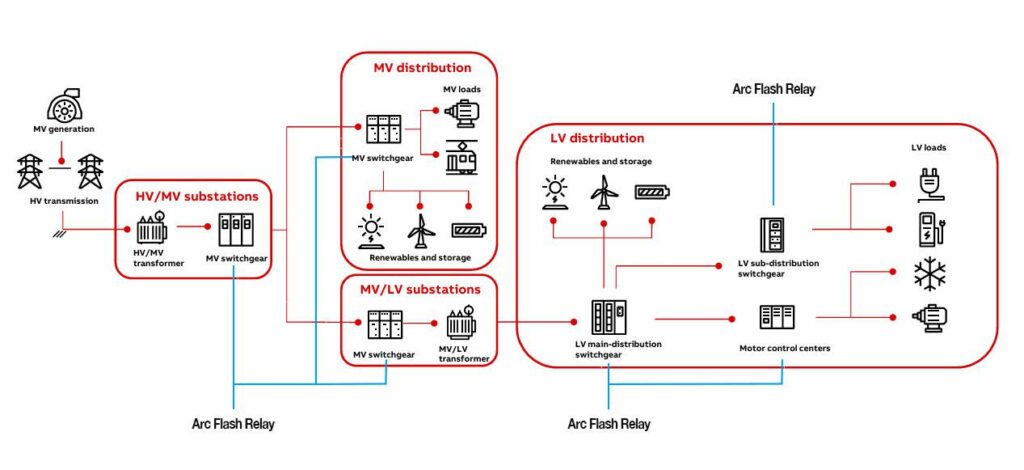
Arc Flash Protection Solution for LV Main-distribution & Sub-distribution Switchgear
In low-voltage power distribution scenarios such as factory power distribution rooms and commercial building power distribution rooms, low-voltage busbars and compensation capacitors are high-risk areas for arc faults. Once an arc fault occurs, it can easily lead to equipment damage, power outages, and even safety risks for personnel. Therefore, low-voltage power distribution system arc-fault protection solutions must specifically address these two high-risk areas. Arc fault sensors are deployed in the low-voltage busbar areas of the incoming and outgoing cabinets. At the same time, arc fault sensors are deployed to target the weak insulation points of the capacitor compensation cabinet (such as capacitor units and wiring terminals) to achieve accurate detection of arc faults. Through the “arc current dual-criterion logic + precise area coverage” architecture, the incoming cabinet is tripped when the conditions are met.
A low-voltage power distribution system generally includes one incoming cabinet, 1-3 capacitor cabinets, and 1-20 outgoing cabinets or more than 20 outgoing cabinets. The specific configuration of arc fault protection relays and arc fault sensors varies depending on the incoming cabinet, capacitor cabinet, and outgoing cabinets.
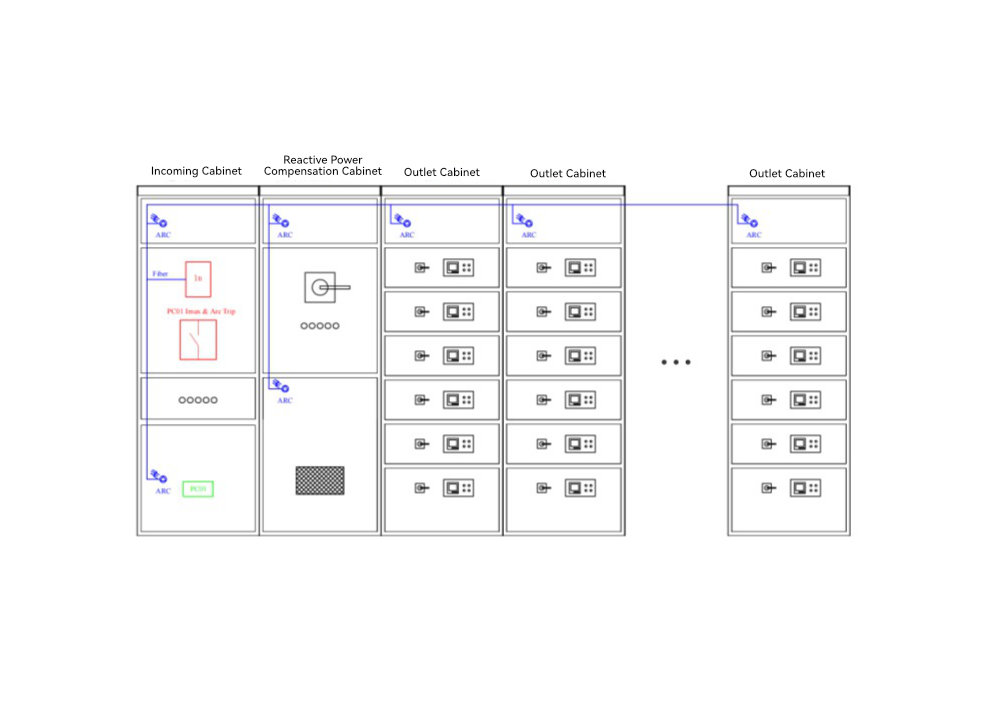
A typical residential community power distribution room configuration is as follows: one incoming cabinet to receive power from the transformer, one capacitor cabinet, and three outgoing cabinets responsible for residential power, public utilities such as water pumps and elevators, and community streetlights and shops, respectively. For this configuration of a low-voltage power distribution system, according to the logic of the low-voltage power distribution system arc fault protection configuration scheme, a total of 7-8 arc fault sensors are needed (2-3 sensors in the main incoming cabinet, 2 sensors in the capacitor cabinet, and one sensor in each of the three outgoing cabinet busbar rooms), along with an 8-channel or 9-channel or more arc fault protection relay. Alternatively, two four-channel arc fault sensors can be configured.
For low-voltage power distribution systems in commercial buildings or factory workshops, the typical configuration is as follows: 1 incoming cabinet, 1-2 capacitor cabinets, and 4-8 outgoing cabinets. The arc fault protection solution requires a total of 8-12 arc fault sensors, an 8-channel or 12-channel arc fault protection relay, or 2-3 four-channel arc fault relays, or 4 three-channel arc fault relays. For low-voltage power distribution systems with a large number of terminal loads or many high-power motors, a common configuration is as follows: 1 incoming feeder panel, 2-3 capacitor panels, and 8-15 outgoing feeder panels. This type of low-voltage power distribution system requires a total of 14-23 arc flash sensors and a 14-channel arc flash protection system.
Arc Flash Protection Solution for Box-type Substation Switchgear
American-style compact substations mainly consist of an incoming line cabinet, metering cabinet, capacitor compensation cabinet, and outgoing line cabinet, with an internal structure comprising a high-voltage compartment, transformer compartment, and low-voltage compartment. The high-risk arc flash areas in the packaged substation include the busbar compartment, circuit breaker compartment, and cable compartment in the high-voltage area, the high and low-voltage connections in the transformer area, and the busbar compartment and compensation capacitors in the low-voltage area. Arc flash protection schemes for packaged substations utilize multi-type sensor front-end sensing and partitioned logic operations of arc flash protection relays, enabling the fault circuit to be disconnected within milliseconds after an arc flash fault occurs.
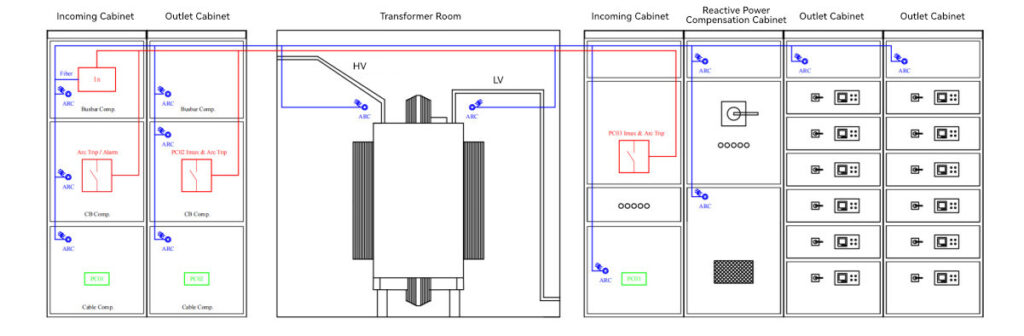
The above image shows an arc flash configuration diagram of a packaged substation, with a total of 13 arc flash sensors installed. One arc flash sensor is installed in the busbar compartment, circuit breaker compartment, and cable compartment of the high-voltage side incoming and outgoing line cabinets in the transformer compartment. One arc flash sensor is installed on both the high-voltage and low-voltage sides of the transformer compartment. One arc flash sensor is installed in the incoming and outgoing line cabinets on the low-voltage side of the transformer compartment, and two arc flash sensors are installed in the capacitor compensation cabinet. Depending on the number of arc flash sensors, either one arc flash protection relay supporting 13 sensors or five four-channel arc flash protection relays can be installed.
Arc Flash Protection For 66KV Substation Switchgear
To address the safety protection needs of the 66KV substation’s 10KV busbar section in the mine, this substation includes two busbar sections and 44 switchgear panels. Comprehensive arc flash protection is required for these 44 switchgear panels, covering the three core areas of each panel: busbar, circuit breaker, and cable head. This ensures precise monitoring, rapid response, and effective handling of arc flash faults.
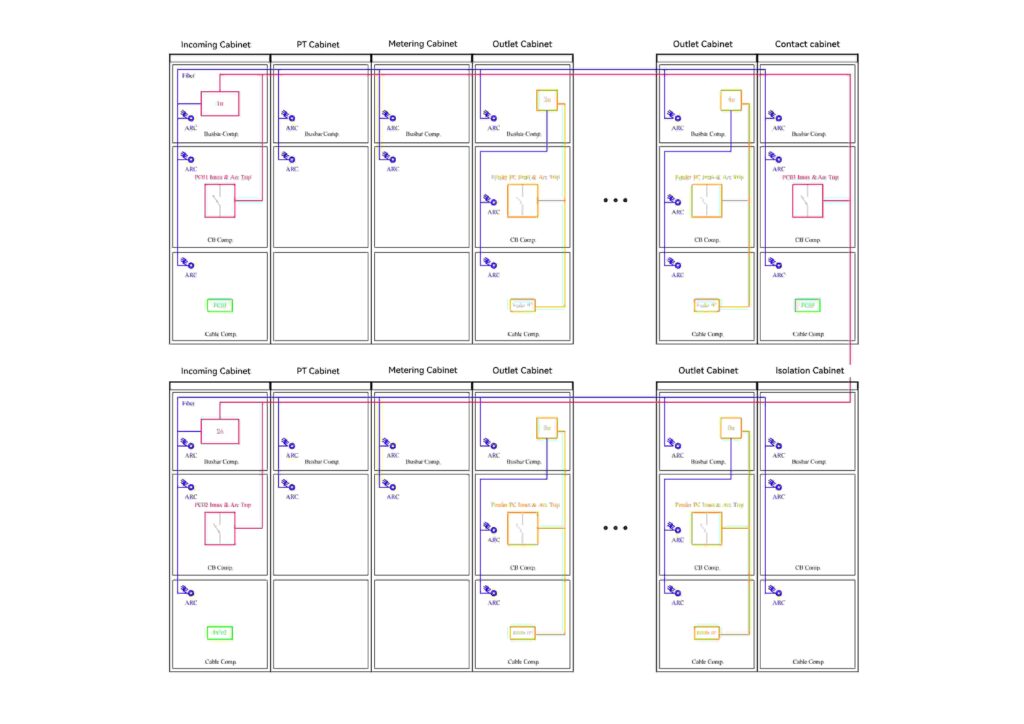
Busbar-type arc flash protection device (e.g., Blue Jay AFR-M): Adapts to the protection needs of the two busbar sections, responsible for monitoring arc flash faults in the busbar compartment, and achieving precise control of the incoming switches and bus coupler switches of the faulty busbar section.
Feeder-type arc flash protection device: Addresses the feeder protection needs of the 44 switchgear panels, used to monitor arc flash faults in the cable compartment and circuit breaker compartment, enabling rapid tripping of the circuit breaker in the faulty circuit.
Arc flash sensors: Installed in the busbar compartment, cable compartment, and switchgear compartment of each switchgear panel to achieve a comprehensive collection of arc flash signals in critical areas.
Arc Protection for Small and Medium-sized Substation Switchgear
In small and medium-sized user substations (such as enterprise power distribution rooms and regional substations), due to the compact equipment layout and diverse load types, the rapid handling of arc faults is particularly crucial. Small and medium-sized user substations can achieve comprehensive monitoring of arc faults by deploying sensors in three high-risk areas for arc faults (busbar room, circuit breaker room, and cable room). Different arc protection strategies are then adopted for different areas. The busbar room uses a dual criterion of incoming current + arc, where the incoming cabinet or bus coupler cabinet is tripped only when the incoming current exceeds the limit and the arc signal is triggered. This design avoids the risk of false tripping caused by a single arc criterion and ensures rapid isolation of busbar faults, preventing the fault from spreading to the entire power supply system. The circuit breaker room and cable room use a pure arc criterion; once the arc sensor detects an arc, the circuit breaker in that cabinet is immediately tripped, and an arc alarm is issued. This strategy balances the speed and regional specificity of fault isolation, preventing power outages in non-faulty areas due to localized faults.
Arc Fault Protection for Medium and Large Substation Switchgear
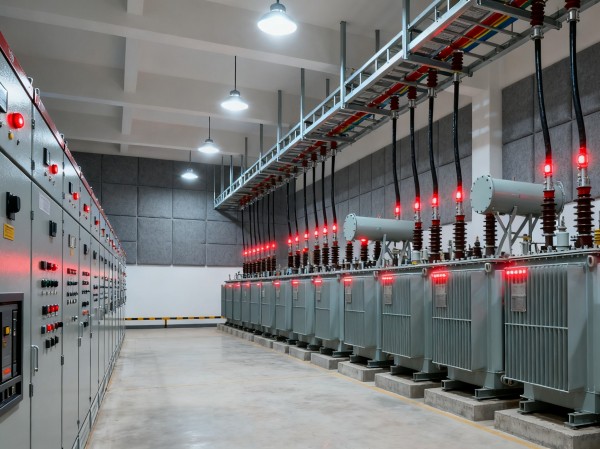
In medium and large-scale power distribution projects (such as substations in industrial parks and main distribution substations of large enterprises), power equipment is densely arranged, and there are numerous feeder circuits. Once an arc fault occurs, it can easily trigger a chain reaction, causing significant equipment damage and power outages. The busbar compartment uses a dual criterion of incoming current exceeding limit and arc flash signal trigger. When both conditions are met simultaneously, the incoming cabinet or bus coupler cabinet is tripped, avoiding the risk of false tripping while ensuring rapid isolation of busbar faults. The circuit breaker compartment and cable compartment also use a dual criterion of feeder current exceeding limit and arc flash signal trigger. When the conditions are met, the circuit breaker in the corresponding cabinet is immediately tripped, adapting to the characteristics of multi-feeder topologies and achieving precise fault circuit localization and isolation.
Arc Flash Protection for Capacitor Compensation Cabinet
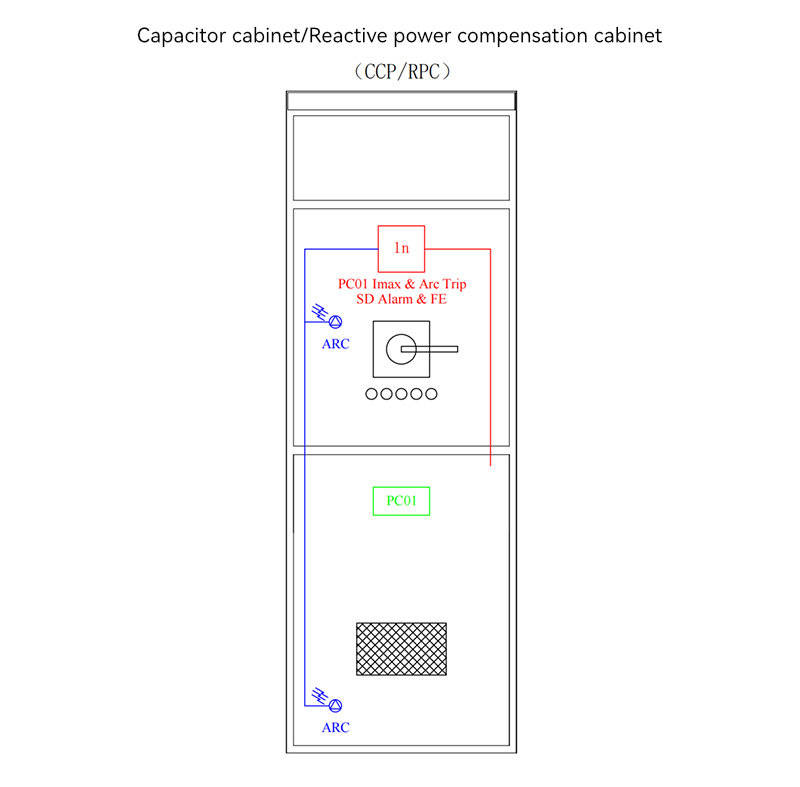
In power systems, capacitor banks (reactive power compensation cabinets) are critical equipment for maintaining reactive power balance in the power grid and ensuring power supply quality.
However, arc faults are prone to occur in the low-voltage busbar and compensation capacitor areas. Therefore, an arc sensor needs to be installed in both the low-voltage busbar compartment and the compensation capacitor area of the capacitor bank.
Simultaneously, a three-channel arc protection relay should be installed on the panel of the low-voltage instrument compartment (protection relay compartment) at the top of the capacitor bank.
Arc Flash Protection for Single Row Distribution Switchgear
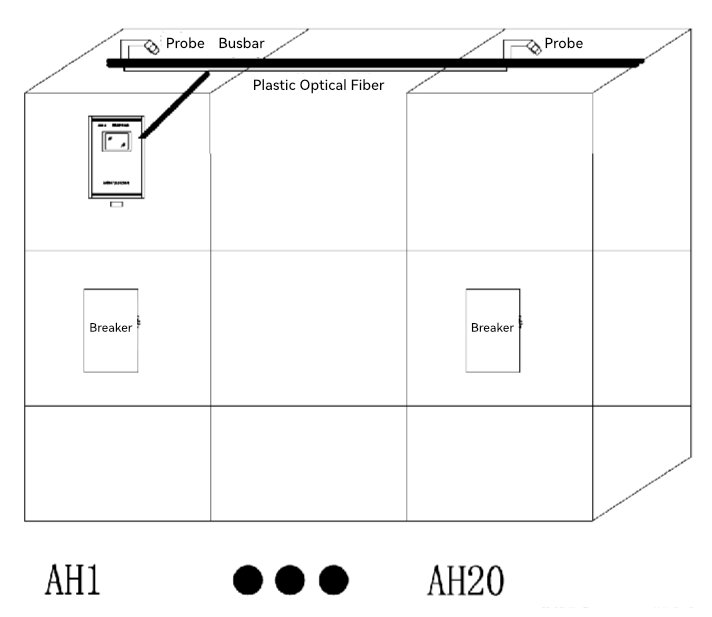
For a scenario involving 20 switchgear panels arranged in a single row within the same distribution or substation, this represents a very standard medium-sized power distribution system. Since there are 20 panels, one arc flash sensor needs to be installed in the busbar compartment, circuit breaker compartment, and cable compartment of each panel, requiring a total of 60 arc flash sensors. Simultaneously, either a multi-channel arc flash protection relay supporting 60 sensors or two arc flash protection relays supporting 12 and 48 channels, respectively, would need to be installed.
Arc Flash Protection for Two Row Distribution Switchgear
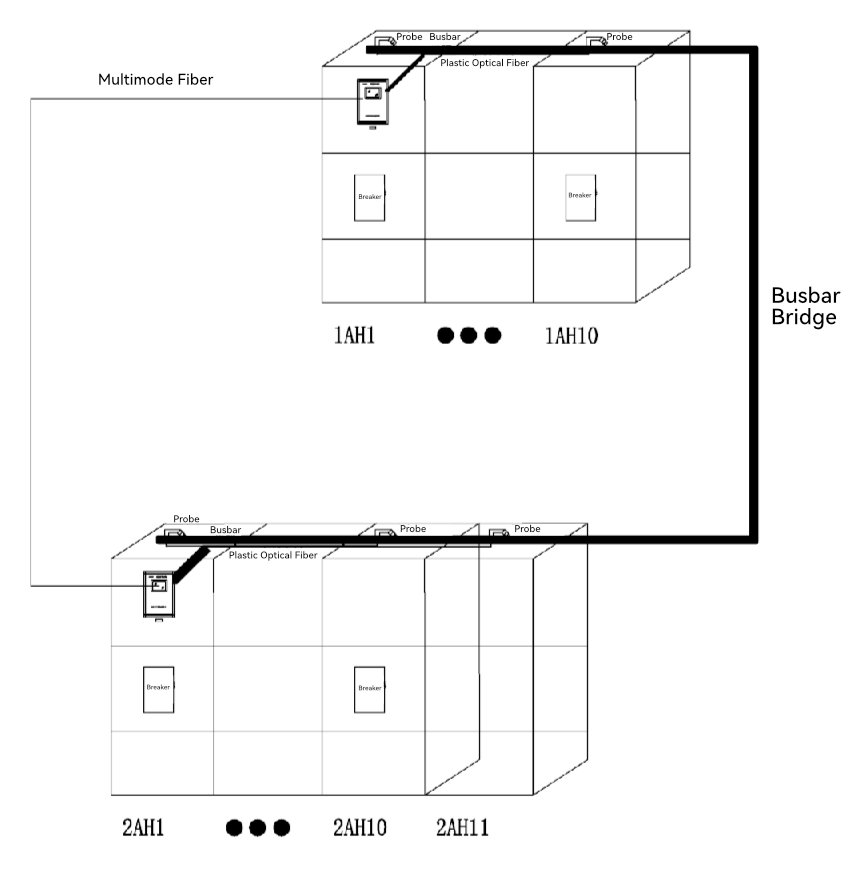
In distribution rooms where switchgears are arranged face-to-face, the electrical cabinets on both sides are typically connected by busbar bridges, meaning the entire power system has two busbar sections (Busbar Section I and Busbar Section II). When configuring arc flash protection for this type of switchgear, using a multi-channel arc flash protection relay is the most economical and safe solution. Users need to install multi-channel arc flash protection relays, such as the Blue Jay AFR-M, in the main incoming switchgears of both Busbar Section I and Busbar Section II. Arc flash detectors or sensors should be installed in the busbar compartments of each electrical cabinet, and the main incoming cabinets of Busbar sections I and II should be connected via fiber optic cables.
Arc Flash Protection For Renovation Switchgear
If you are upgrading your power system and need to quickly detect and isolate arc faults within switchgear, then configuring an arc flash protection system can effectively reduce the impact of such faults.
For the busbar compartment of the switchgear, an incoming current and arc flash criterion is used. Upon activation, it trips the incoming feeder and bus coupler compartments. This design quickly isolates busbar faults and prevents the fault from spreading to the entire busbar system.
For the circuit breaker compartment of the switchgear, a feeder current and arc flash criterion is used, tripping the corresponding compartment upon activation. This ensures precise fault isolation for the feeder circuit without affecting power supply to other circuits.
For the cable compartment of the switchgear, similarly, a feeder current and arc flash criterion is used, tripping the corresponding compartment upon activation, specifically protecting against arc faults in the cable circuit.