
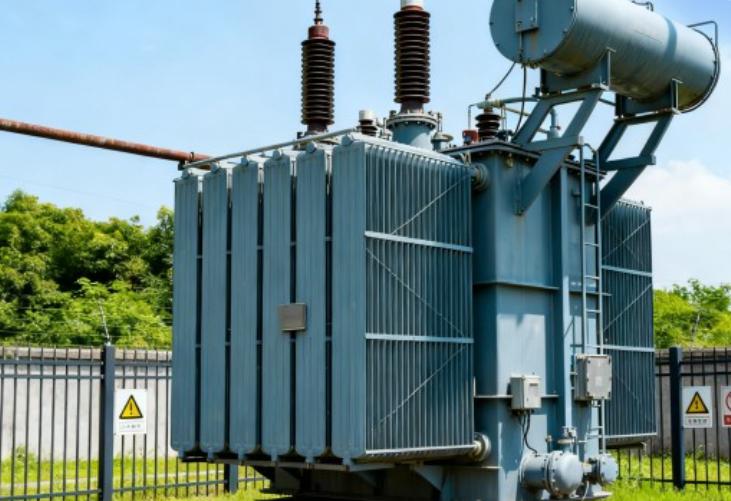
In power systems, transformers are core equipment for electrical energy transmission and transformation, and their safe and stable operation directly impacts the reliability of the power grid. Transformer rooms, due to the high density of equipment and concentrated electrical energy, are prone to faults such as arcing, partial discharge, and high temperatures, which can lead to fires and equipment damage in severe cases. Based on this, this arc flash protection system solution constructs a multi-dimensional, comprehensive protection system incorporating arc flash detection, partial discharge detection, temperature monitoring, smoke detection, and fire suppression.
Core Components of the Transformer Arc Flash Protection Solution
Arc Flash Protection Relay: As the central hub of the system, it performs signal acquisition, logical calculations, and command output functions, ensuring the coordinated operation of all components.
Arc Flash Sensors: Deployed in key areas of the transformer room, they enable rapid detection and transmission of arc flash signals.
Extended Functional Components: These include partial discharge monitoring devices, temperature monitoring devices, smoke monitoring devices, and fire extinguishing devices, providing multi-layered protection from fault warning to fire suppression.
Transformer Monitoring and Protection Logic
Monitoring Area: Focusing on the transformer room, covering core areas such as the high-voltage and low-voltage sides of the transformer – these areas are critical nodes for electrical energy conversion, where partial discharge, arcing, and high-temperature fault risks are concentrated. Targeted monitoring can accurately detect potential hazards.
Transformer Arc Flash Protection: When abnormal incoming current and arc flash signals are simultaneously detected, the arc flash protection relay triggers the associated equipment to trip, avoiding false trips/failures based on a single criterion and ensuring the reliability of fault clearing.
Multi-dimensional Warning and Fire Suppression for Transformers: Partial discharge sensors monitor partial discharge (an early signal of insulation degradation), temperature sensors capture equipment overheating trends, and smoke sensors detect fire precursors; if a fire occurs, the fire suppression system is immediately activated to quickly extinguish the fire at its initial stage and interrupt the fault chain.
Arc Flash Protection Solution for Transformer Safety
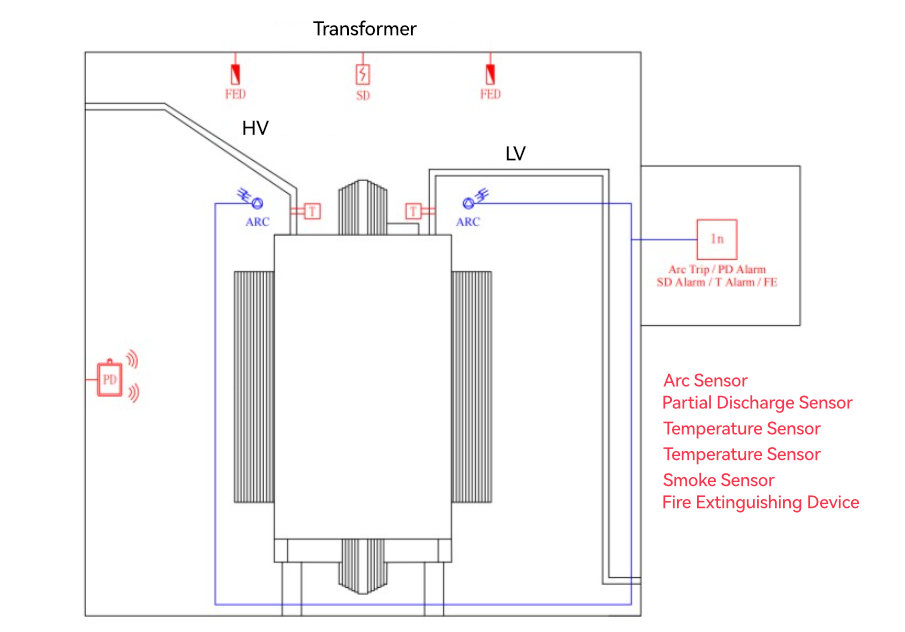
The transformer arc flash protection scheme shown in the image above establishes a complete protection loop encompassing arc flash/partial discharge/temperature monitoring → fault clearing → smoke warning → fire extinguishing:
Proactive: Through partial discharge and temperature monitoring, it achieves “early detection and early warning” of faults, eliminating potential hazards in their nascent stage; arc flash protection responds quickly to sudden faults, cutting off the power supply in milliseconds to prevent catastrophic damage to the equipment.
Comprehensive: From electrical faults (arc flash, partial discharge) to thermal faults (high temperature), and then to the resulting fire risk, it covers typical fault scenarios in the transformer room from multiple dimensions, building a multi-layered defense line for transformer safety.
Reliable: The design, incorporating multiple criteria and coordinated operation of multiple devices, ensures stable system operation under complex working conditions, providing solid support for the long-term reliable operation of transformers and guaranteeing power grid quality.
Conclusion
In summary, this comprehensive transformer monitoring and arc flash protection system solution effectively addresses multiple fault hazards in the transformer room, including arc flash, partial discharge, and high temperature, through the comprehensiveness of its hardware configuration, the rigor of its logical criteria, and the expandability of its protection functions. It is a key technical solution for improving transformer operational reliability and ensuring the safety and stability of the power grid.